
Key Signatures Chart
A key signature tells you which notes are sharp or flat throughout a piece — and reading it instantly is one of the first real milestones in music theory. Pick any key on the circle of fifths to see its signature on both staves, its scale and chords, then test yourself with the quiz.
- Free to use
- No sign-up
- Runs in your browser
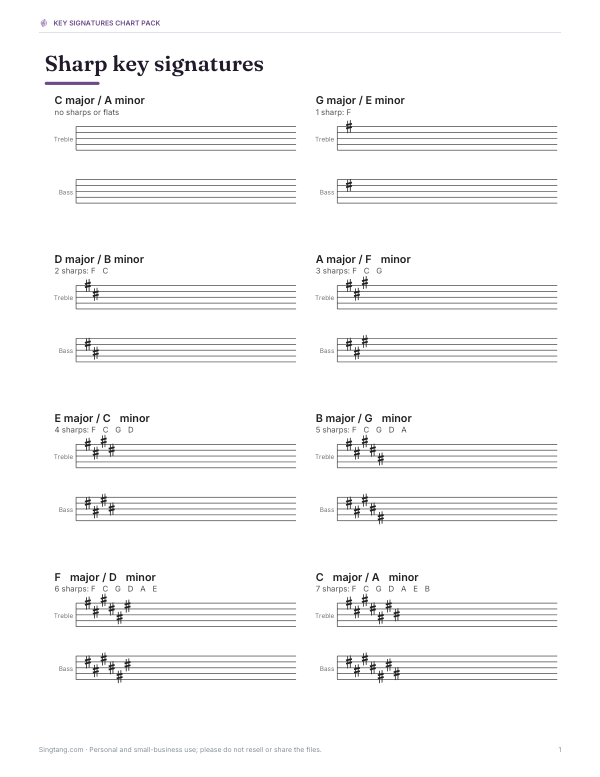
Key signatures chart
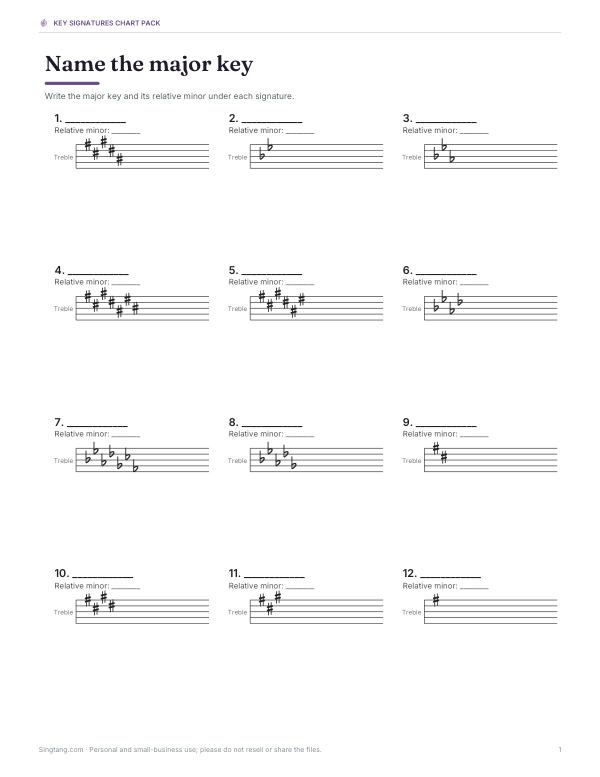
Quiz: name the key
Key Signatures Chart Pack
All four PDFs (6 pages) are free individually. The optional $5 ZIP contains the same four PDFs plus README in one download (5 files total). It adds convenience, not exclusive content or editable files.
- Key signatures chart (PDF)
- Circle of fifths table (PDF)
- Key signature quiz (PDF)
- Blank staff paper (PDF)
Formats: PDF. Instant download after payment (link valid 72 hours, up to 5 downloads). AI-assisted: the templates were drafted with AI help and reviewed and laid out before publishing.
$5.00 USD, one-time 4 PDFs (6 pages) + README
- Instant download
- 7-day refund
- Secure checkout by Stripe
7-day money-back guarantee. Full refund within 7 days of purchase, even after you download.
Free sample: Blank Staff Paper (PDF, 60 KB)
Full refund within 7 days — see the refund policy and license.
Free printables
Single sheets you can print right now, no sign-up. The full pack adds every sheet in one download plus the editable files.
 Printable Blank Staff Paper
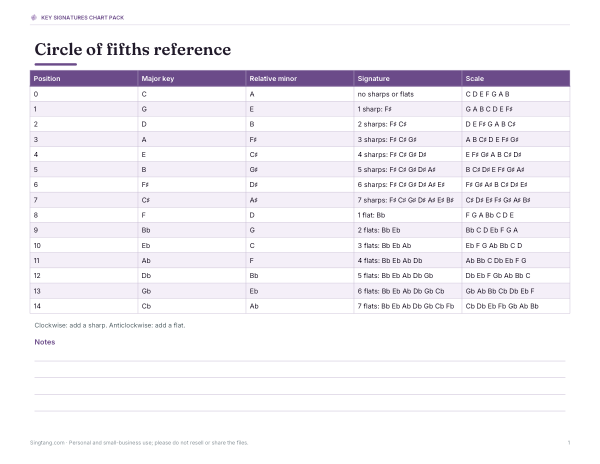
All key signatures
| Major key | Relative minor | Key signature |
|---|---|---|
| C major | A minor | no sharps or flats |
| G major | E minor | 1 sharp: F♯ |
| D major | B minor | 2 sharps: F♯ C♯ |
| A major | F♯ minor | 3 sharps: F♯ C♯ G♯ |
| E major | C♯ minor | 4 sharps: F♯ C♯ G♯ D♯ |
| B major | G♯ minor | 5 sharps: F♯ C♯ G♯ D♯ A♯ |
| F♯ major | D♯ minor | 6 sharps: F♯ C♯ G♯ D♯ A♯ E♯ |
| C♯ major | A♯ minor | 7 sharps: F♯ C♯ G♯ D♯ A♯ E♯ B♯ |
| F major | D minor | 1 flat: B♭ |
| B♭ major | G minor | 2 flats: B♭ E♭ |
| E♭ major | C minor | 3 flats: B♭ E♭ A♭ |
| A♭ major | F minor | 4 flats: B♭ E♭ A♭ D♭ |
| D♭ major | B♭ minor | 5 flats: B♭ E♭ A♭ D♭ G♭ |
| G♭ major | E♭ minor | 6 flats: B♭ E♭ A♭ D♭ G♭ C♭ |
| C♭ major | A♭ minor | 7 flats: B♭ E♭ A♭ D♭ G♭ C♭ F♭ |
Three pairs of keys sound the same on a piano but are written differently (enharmonic keys): B and C♭ major, F♯ and G♭ major, C♯ and D♭ major. Composers usually choose the spelling with fewer accidentals.
The order of sharps and flats
Sharps always appear in the order F♯ C♯ G♯ D♯ A♯ E♯ B♯ — remembered as “Father Charles Goes Down And Ends Battle”. Flats appear in the reverse order, B♭ E♭ A♭ D♭ G♭ C♭ F♭ — “Battle Ends And Down Goes Charles’ Father”. A key signature with three sharps always has F♯, C♯ and G♯; one with two flats always has B♭ and E♭.
Naming the key from the signature
- Sharp keys: the last sharp is the 7th note of the major scale, so go up a half step. Last sharp G♯ → A major.
- Flat keys: the second-to-last flat is the name of the major key. Flats B♭ E♭ A♭ → E♭ major.
- One flat is F major — memorise it.
- No sharps or flats is C major or A minor.
- The relative minor is three half steps (a minor third) below the major key.
Major or minor?
Every key signature is shared by a major key and its relative minor — G major and E minor both have one sharp. To tell which one a piece is in, look at the first and last notes and chords: a piece in E minor usually begins and ends on E or an E minor chord. Minor-key music also often has a raised seventh written as an accidental — D♯ in E minor — because the harmonic minor scale raises the seventh note.
Scales in each key
| Key | Scale notes |
|---|---|
| C major | C D E F G A B |
| G major | G A B C D E F♯ |
| D major | D E F♯ G A B C♯ |
| A major | A B C♯ D E F♯ G♯ |
| E major | E F♯ G♯ A B C♯ D♯ |
| B major | B C♯ D♯ E F♯ G♯ A♯ |
| F♯ major | F♯ G♯ A♯ B C♯ D♯ E♯ |
| C♯ major | C♯ D♯ E♯ F♯ G♯ A♯ B♯ |
| F major | F G A B♭ C D E |
| B♭ major | B♭ C D E♭ F G A |
| E♭ major | E♭ F G A♭ B♭ C D |
| A♭ major | A♭ B♭ C D♭ E♭ F G |
| D♭ major | D♭ E♭ F G♭ A♭ B♭ C |
| G♭ major | G♭ A♭ B♭ C♭ D♭ E♭ F |
| C♭ major | C♭ D♭ E♭ F♭ G♭ A♭ B♭ |
Worked example
A student sees a key signature of four sharps. The order of sharps gives F♯ C♯ G♯ D♯; the last sharp is D♯, and a half step up is E — so the piece is in E major (E F♯ G♯ A B C♯ D♯) or its relative minor, C♯ minor. The piece ends on a C♯ minor chord and has several B♯ accidentals (the raised seventh), so it is in C♯ minor. In the tool, choosing E major and switching the mode to relative minor shows the same signature with the scale C♯ D♯ E F♯ G♯ A B.
Key signatures on the staff
Sharps and flats in a key signature are always written in the same positions on the staff, so the pattern becomes recognisable at a glance. In treble clef the first sharp, F♯, sits on the top line; C♯ is in the third space; G♯ sits just above the staff. The first flat, B♭, is on the middle line of the treble staff and E♭ in the top space. In bass clef the pattern is the same shape, two staff steps (a third) lower. The key signature appears at the start of every line of music, after the clef and before the time signature, and applies to that note in every octave.
Accidentals and key changes
- An accidental (♯, ♭ or ♮) applies to that note letter at the same octave until the bar ends; a tie can carry it across the barline.
- A natural sign cancels a sharp or flat from the key signature for that bar.
- A new key signature mid-piece, usually after a double bar line, signals a modulation.
- Cautionary accidentals in brackets are reminders, not changes.
Why the circle of fifths works
Moving clockwise around the circle, each key is a perfect fifth above the previous one and adds one sharp; moving anticlockwise, each key is a fifth below (a fourth above) and adds one flat. Neighbouring keys share six of their seven notes, which is why music often modulates to the key a fifth up or down — and why the chords I, IV and V of any key sit next to each other on the circle.
Privacy
Everything runs in your browser.
Frequently asked questions
How many key signatures are there?
15 written major key signatures (0 to 7 sharps or flats), each shared with a relative minor.
What is the order of sharps?
F C G D A E B.
What is the order of flats?
B E A D G C F.
What key has one sharp?
G major or E minor.
What key has one flat?
F major or D minor.
How do I find the relative minor?
Go down three half steps from the major key, or use the 6th note of the major scale.